While DJs Fight Over AI-Generated Music, Something Far More Disruptive Is Moving Into the DJ Booth
While much of the music industry has spent the past couple of years arguing about AI-generated music, another technological shift has been quietly developing on the other side of the DJ booth. It isn't generating tracks. It's learning how DJs organize them, prepare them, connect them and, increasingly, decide what to play next.
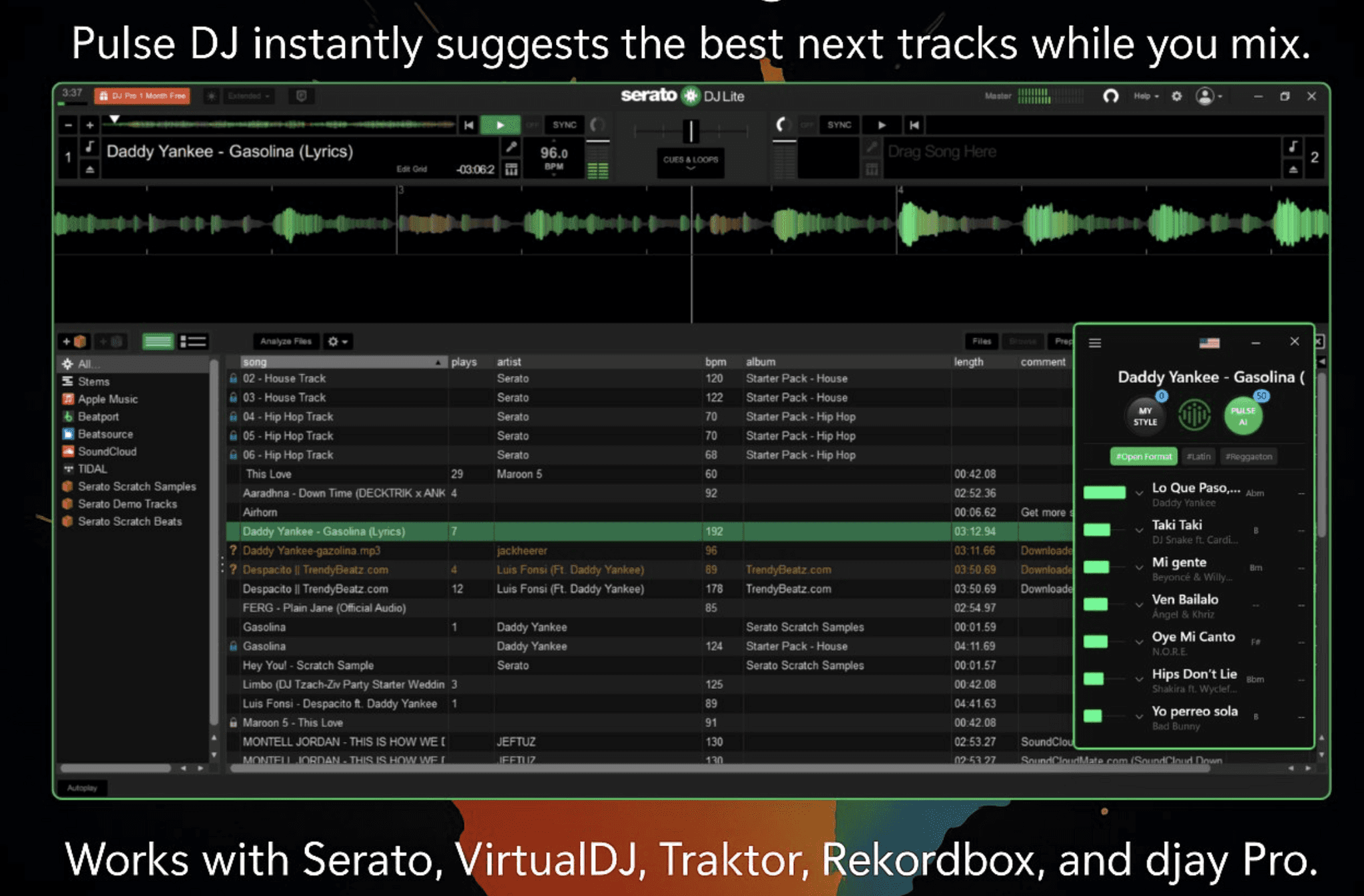
A growing collection of platforms including DJOID, PulseDJ, Crate Hackers, waveAlign, VirtualDJ, Lexicon DJ and Platinum Notes are attacking different parts of a process that DJs have traditionally handled themselves. None of these products alone represents some autonomous AI DJ, and treating them as though they all do the same thing misses the bigger story. Taken together, however, they reveal a pretty dramatic change in the way DJs are preparing music and performing with it.
DJOID, for example, focuses heavily on curation. It analyzes a DJ's collection and uses musical characteristics to identify tracks that may work together. Its Matching Tracks system can suggest music that works with a current selection, while Magic Sort can reorganize a playlist according to factors including harmonic compatibility and energy. Its Graph Playlists and Scatter Map take the idea further, turning a collection into a visual network of musical relationships rather than just a folder full of files.
PulseDJ approaches the same basic problem from a completely different direction. Rather than simply asking what two tracks look like mathematically, Pulse draws on observed DJ behavior. The company currently says its system has analyzed more than 5.9 million parties and 524 million song pairings across roughly 429,000 unique tracks. The result is essentially a live digital copilot. Play a track and Pulse can offer ideas for what might work next based, in part, on what DJs have actually played together.
That number deserves some consideration. Track knowledge has historically been one of the great dividing lines between experienced DJs and everyone else. A veteran might remember that some obscure track from 2004 works beautifully after a particular modern house track because they stumbled onto the combination years ago. Software can now begin surfacing those kinds of relationships from a body of observed behavior no individual DJ could accumulate in a lifetime.
Crate Hackers attacks the workload from another direction. It scans music libraries, helps DJs build and organize crates, matches song ideas against files they actually own and moves those results into DJ software. Its separate Banger Button product pushes further into next-track exploration. Lexicon DJ, meanwhile, has developed into something approaching a master library layer, capable of analyzing BPM, beatgrids, key and energy, generating cue points, moving libraries between major DJ platforms and producing lists of tracks that meet user-defined mixability rules.
Then there are tools working on the tracks themselves. waveAlign tackles one extremely specific problem: inconsistent loudness. It analyzes and normalizes a DJ's collection using LUFS-based loudness measurement, applying limiting where necessary while preserving the library information DJs depend on. Platinum Notes goes further into corrective audio processing, analyzing volume, repairing clipped peaks, correcting pitch problems and producing optimized copies of tracks.
Even traditional DJ software is changing. VirtualDJ's Live Feedback can recommend music according to what other DJs commonly played after the track currently on the deck. Its newer AI-powered Fluid Beatgrids analyze material with unstable or changing tempos, while BPM Stabilizer can steady that material so it can be manually beatmixed. Add modern stem separation to the equation and the amount of assistance available inside the booth is substantially different from what existed even a few years ago.
Individually, none of this means the DJ has disappeared. Collectively, though, it raises a much more interesting question about what DJ skill is going to mean.
When the crate was finite
For decades, DJing involved accumulating several kinds of knowledge at the same time. In the vinyl era, that knowledge was intensely physical. You bought records. You carried them. You knew what was buried on the B-side. You knew which record was cut loud and which one needed gain. You knew where the break was because you had played the record a hundred times. You recognized it from the sleeve, the label, or even the position it occupied in your crate. You learned which records worked together because you stood behind the decks and tried them.
There was another part of that culture that is easy to overlook now: scarcity.
Records were physical objects produced in finite numbers. Some were pressed by the thousands. Others might exist in only a few hundred copies. Promos, white labels, imports and small independent releases could be genuinely difficult to find. When the copies were gone, they were gone unless somebody who owned one was willing to sell it or trade it.
That mattered enormously to DJ culture. If you heard another DJ play an incredible record, knowing what it was didn't necessarily mean you could play it next weekend. You still had to find the thing. Maybe your local record store had one. Maybe somebody knew a distributor. Maybe you called another shop across the country. Maybe you found somebody willing to trade. Sometimes acquiring a record literally meant that another DJ no longer owned it.
The hunt was part of the craft.
It also meant two DJs could walk into the same record store with the same amount of money and emerge with completely different collections. Your sound wasn't determined only by what you liked. It was shaped by what you could actually find.
That scarcity created value around knowledge as well. Knowing which labels to watch, which shops got particular imports, which distributor had received a shipment, or which record sitting anonymously in a bin contained the track everybody was trying to identify could provide a real advantage. A DJ's collection wasn't simply a playlist. In many cases it represented years of searching, trading, traveling, relationships and accumulated knowledge.
Then DJing went digital, and one of the fundamental rules of that world disappeared.
A digital file doesn't become unavailable because somebody else downloaded it. Acquiring a track doesn't require another person to give up their copy. Once music can be reproduced perfectly and distributed essentially without limit, scarcity largely disappears from the equation.
That was an extraordinary democratization of music, and there were enormous benefits. DJs suddenly had access to tracks they might never have encountered otherwise. Independent artists could distribute music globally without pressing vinyl. Entire catalogs became available to people who lived nowhere near a specialist record store.
But something was lost in the exchange.
Suddenly thousands of tracks could live on a laptop or USB drive. BPMs were calculated for you. Waveforms showed you where the breakdown was coming. Software identified musical keys. Sync could handle much of the mechanical work of matching tempos. Search boxes replaced digging through a physical crate.
A DJ could possess 10,000 tracks without really knowing 10,000 tracks.
The move to digital didn't suddenly eliminate taste or talent, and vinyl scarcity itself never guaranteed either one. But it removed a barrier that had once forced DJs to develop a particularly intimate relationship with the music they actually possessed. The physical limitations of the crate demanded choices. You couldn't bring everything. You couldn't necessarily acquire everything. And what you did manage to find became part of your identity.
As the physical scarcity disappeared, more and more of the information that once had to live inside the DJ's head also began migrating into the screen.

AI-assisted preparation is the next step in that progression. BPM becomes data. Key becomes data. Energy becomes data. Loudness becomes data. Cue positions become data. Musical similarity becomes data. The selections made by hundreds of thousands of other DJs become data.
Once those things become data, software can begin doing something much more consequential than simply displaying information. It can start making suggestions and decisions with it.
The New DJ Prep Stack
These are not seven versions of the same product. They attack different parts of the preparation and performance chain. Put together, they show how much of the traditional DJ workflow can now be assisted by software.
There is still a very important line that software has not crossed.
It doesn't look up and see that half the dance floor just arrived from another party. It doesn't notice that the crowd is getting restless even though every metric says the current track should be working. It doesn't see three people lose their minds when you tease an old vocal and realize there may be an entirely different direction available. It doesn't feel the tension before a breakdown or recognize that tonight is simply not the night for the set you spent four hours preparing at home.
A dance floor isn't a spreadsheet, and DJing has never been entirely about finding two technically compatible pieces of music.
Great DJs respond to people. They take risks. They make mistakes. They abandon plans. They recognize when something unexpected is happening in the room and follow it.
At least for now, that remains an enormous distinction.

But dismissing these new systems because they cannot read a room would also miss what makes them potentially disruptive. They don't have to replace a great DJ to change DJing. They merely have to make an inexperienced or mediocre DJ considerably more capable.
The person who once opened a folder containing 2,000 tracks and had little idea where to begin can increasingly have software organize those tracks, analyze their musical characteristics, suggest compatible selections, normalize their levels, generate cue points and offer another track when they get stuck during a set.
That raises the floor.
And raising the floor may ultimately prove more consequential than raising the ceiling.
The exceptional selector, the DJ who can read a room, abandon the plan, take a risk and find a track nobody else would have considered, isn't suddenly obsolete. In fact, as recommendation systems become commonplace, genuinely individual taste may become even more valuable.
What is changing is the amount of experience required to reach basic competence.
Some of the mechanical, technical and informational advantages that once came only through years spent collecting music and playing it are increasingly available through software. First the computer told us the BPM. Then it showed us the waveform. Then it gave us the key. Then it synchronized the tracks.
Now it's starting to tell us what track to play next.
That's why the fixation on AI-generated music may have obscured the more immediate transformation happening inside DJ culture. The interesting question isn't simply whether AI can make a house track.
The more uncomfortable question is what happens when the DJ standing behind the decks has a machine beside them that knows the BPM, key, energy, structure and technical condition of every track they own, can search those tracks instantly, remembers combinations they have forgotten, has access to patterns derived from millions of other performances and can quietly suggest the next move.
The machine doesn't need to take over the decks.
It just needs to keep getting better at whispering in the DJ's ear.
And if that continues, the argument over AI and DJ culture is about to become considerably more complicated.
Because AI isn't only learning how to make the tracks anymore. It's learning how we choose them.